publications!
composing informational atmospheres
ACM DIS26 - Designing Interactive Systems
Singapore
pictorial paper
June 2026
Composing Informational Atmospheres
A Research-Through-Design Method Using Reduced Perceptual Cues
This pictorial introduces Reduced Perceptual Cues (RPC) as a design method for composing spatial and interactive experiences through limited sensory information. Rather than relying on explicit interfaces, discrete interaction events, or high-fidelity representation, RPC works with selected cues such as light, sound, airflow, temperature, reflection, haze, and material presence.
The project proposes a compositional approach supported by three connected elements: a card-based design process, computational workflows for perceptual distillation, and modular sensory assemblies. Together, these tools make perceptual conditions more tangible as design material, allowing designers to explore how atmosphere, ambiguity, and interpretation can emerge through reduced sensory compositions.
The work was presented as a pictorial at DIS 2026 in Singapore, with parts of the research also shown during the Interactivity sessions, including the design card deck and a web-based example of the computational workflows.
Co-author: Laura Schütz
Academic advisors: Takatoshi Yoshida and Kouta Minamizawa
Full Paper: https://doi.org/10.1145/3800645.3812809
A Research-Through-Design Method Using Reduced Perceptual Cues
This pictorial introduces Reduced Perceptual Cues (RPC) as a design method for composing spatial and interactive experiences through limited sensory information. Rather than relying on explicit interfaces, discrete interaction events, or high-fidelity representation, RPC works with selected cues such as light, sound, airflow, temperature, reflection, haze, and material presence.
The project proposes a compositional approach supported by three connected elements: a card-based design process, computational workflows for perceptual distillation, and modular sensory assemblies. Together, these tools make perceptual conditions more tangible as design material, allowing designers to explore how atmosphere, ambiguity, and interpretation can emerge through reduced sensory compositions.
The work was presented as a pictorial at DIS 2026 in Singapore, with parts of the research also shown during the Interactivity sessions, including the design card deck and a web-based example of the computational workflows.
Co-author: Laura Schütz
Academic advisors: Takatoshi Yoshida and Kouta Minamizawa
Full Paper: https://doi.org/10.1145/3800645.3812809
Crafting Informational Atmospheres
CAADRIA25Architectural Informatics Conference
Tokyo University, Japan
workshop + exhibition
March 2025
A 4-day workshop at CAADRIA 2025 in Tokyo explored how spatial experiences can be constructed using reduced perceptual cues. Using the Informational Atmosphere Toolbox, participants worked in teams to translate atmospheric references into compositions based on light, sound, airflow, and material elements.
The workshop concluded with a public exhibition, where visitors experienced the installations and shared feedback. The outcomes contribute to ongoing research on how reduced perceptual cues can communicate atmosphere and spatial intention while reducing informational complexity.
![]()
![]()
+ more info
The workshop concluded with a public exhibition, where visitors experienced the installations and shared feedback. The outcomes contribute to ongoing research on how reduced perceptual cues can communicate atmosphere and spatial intention while reducing informational complexity.


+ more info
em-ex exhibition
Tokyo Portcity TakeshibaTokyo, Japan
exhibition
December 2024

Encounters Exhibition
Design Festa GalleryHarajuku, Japan
exhibition
May 2024

Medienkunstpreis 2021
Bauhaus-Universität WeimarFakultät Kunst und Gestaltung
nomination - exhibition
July 2021
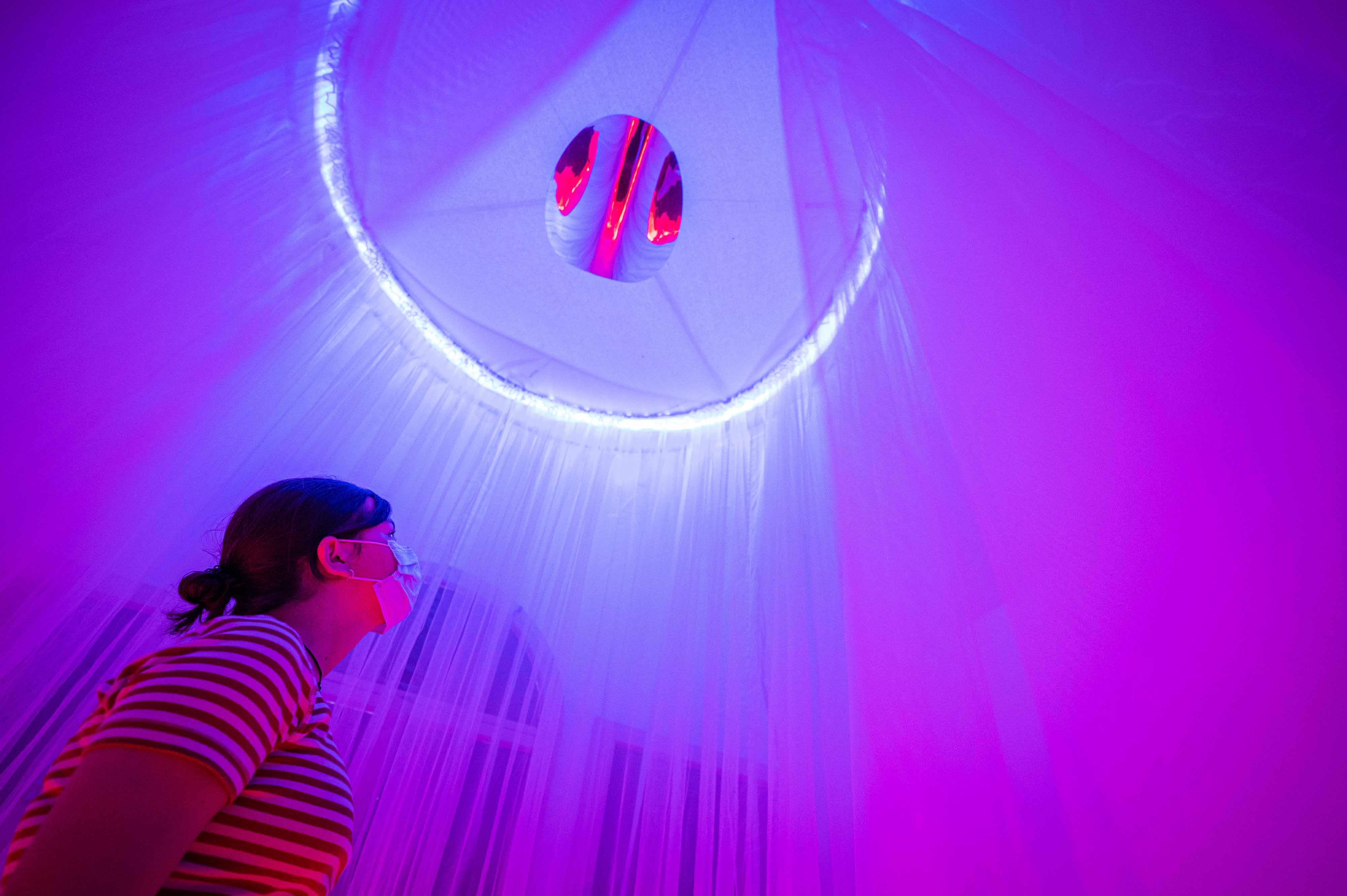
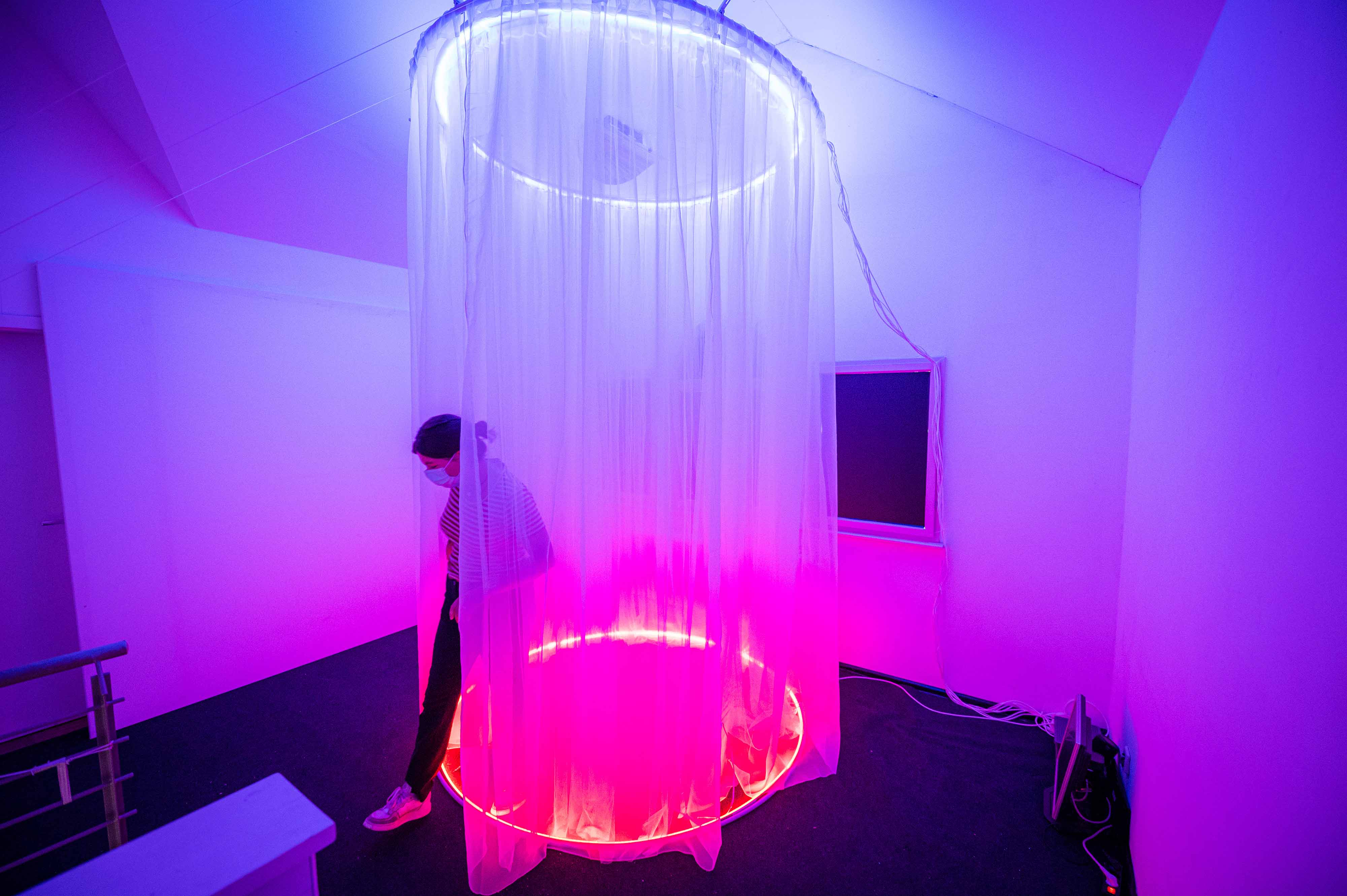
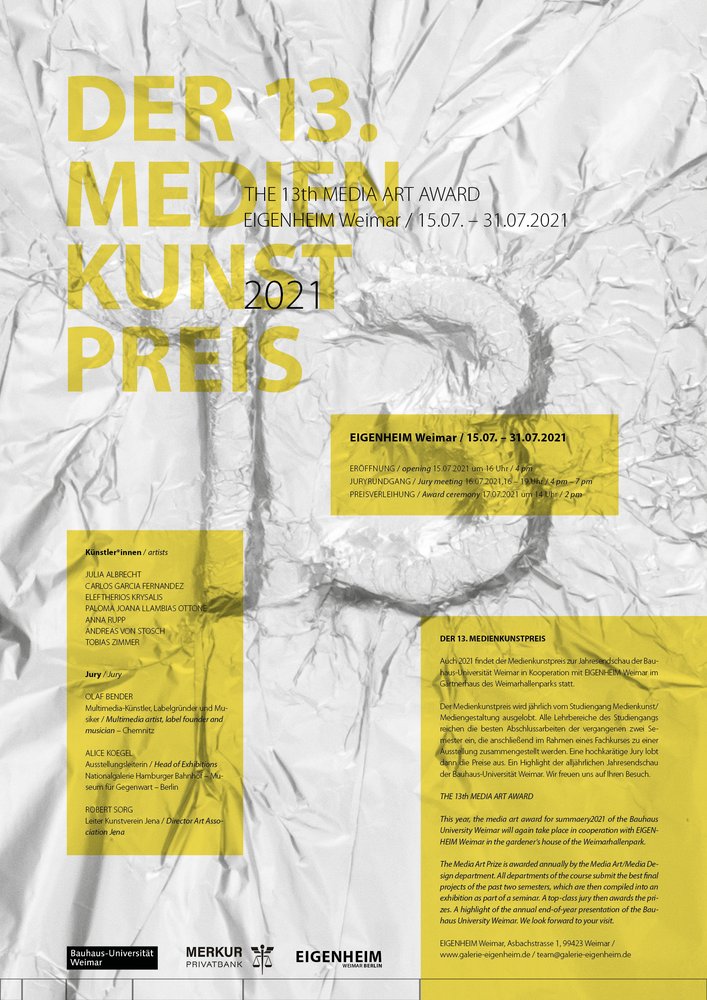
atmospheric spaces nominated for the price Medienkunstpreis 2021 by the Interface Design Department, Art and Design Faculty, at the Buahaus-Universtiät Weimar.
Showcased at the Galerie Eigemheim, Weimar.
+info
![]()
![]()
![]()
Showcased at the Galerie Eigemheim, Weimar.
+info
aa
MAB academy
Towards Media Architecture Publication
MAB - Media Archirecture Biennale 2021publication
June 2021
atmospheric spaces featured at the MAB acedemy - Towards Media Architecture Publication, issued for the Media Architecture Biennale 2021.
[The MAB Academy is a new initiative that contributes to the development of media architecture as an academic and pedagogical field. In this context a MAB Education Publication Towards Media Architecture was created that provides an overview of media architecture teaching, globally.]
![]()
+full article
+issue
[The MAB Academy is a new initiative that contributes to the development of media architecture as an academic and pedagogical field. In this context a MAB Education Publication Towards Media Architecture was created that provides an overview of media architecture teaching, globally.]

+full article
+issue
kultur satelliten
translocative spaces
Bauhaus Museum WeimarKlassik Stiftung Weimar
exhibition
March 2020
Wiederholte Spiegelungen exhibited at the Bauhaus Museum Weimar as part of the exhibition Kultur Satelliten - translocative spaces, developed in cooperation with Klassik Stiftung Weimar.
[Im Rahmen des Projekts „Kulturportale“ kooperiert die Klassik Stiftung im WS 2019/20 mit dem Lehrstuhl für Interface Design der Bauhaus-Universität. Die Studierenden entwerfen Prototypen insbesondere zur Hauptaufgabe des Kulturportals, die Besucher*innen ausgehend von Weimar zu animieren, auch andere, (kultur-)geschichtlich interessante Orte in Thüringen zu besuchen. Die besten Arbeiten werden in Form einer Werkschau präsentiert. Die Werkschau ist interaktiv und partizipativ konzipiert, da die Besucher*innen eingeladen sind, die Prototypen im Sinne von Hands-on-Stationen selbst auszuprobieren.]
![]() +project
+project
+info
[Im Rahmen des Projekts „Kulturportale“ kooperiert die Klassik Stiftung im WS 2019/20 mit dem Lehrstuhl für Interface Design der Bauhaus-Universität. Die Studierenden entwerfen Prototypen insbesondere zur Hauptaufgabe des Kulturportals, die Besucher*innen ausgehend von Weimar zu animieren, auch andere, (kultur-)geschichtlich interessante Orte in Thüringen zu besuchen. Die besten Arbeiten werden in Form einer Werkschau präsentiert. Die Werkschau ist interaktiv und partizipativ konzipiert, da die Besucher*innen eingeladen sind, die Prototypen im Sinne von Hands-on-Stationen selbst auszuprobieren.]
 +project
+info